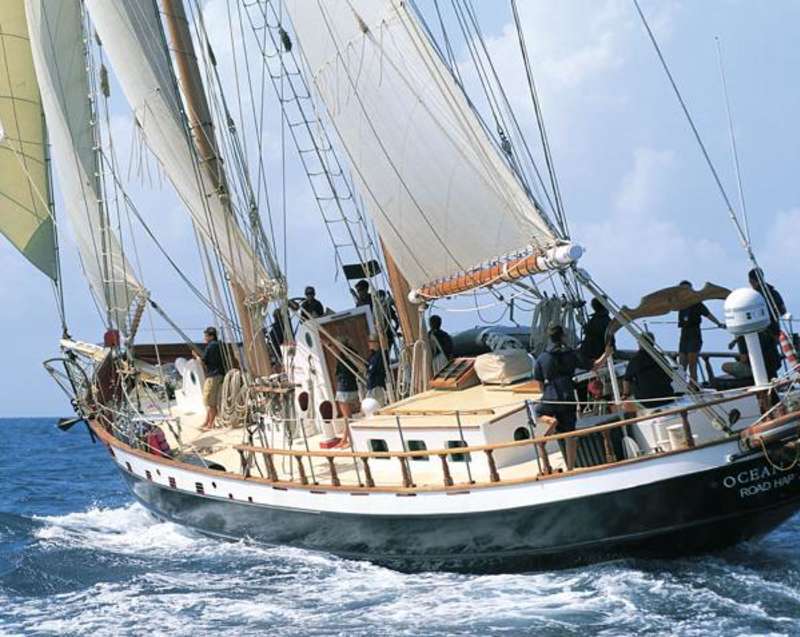
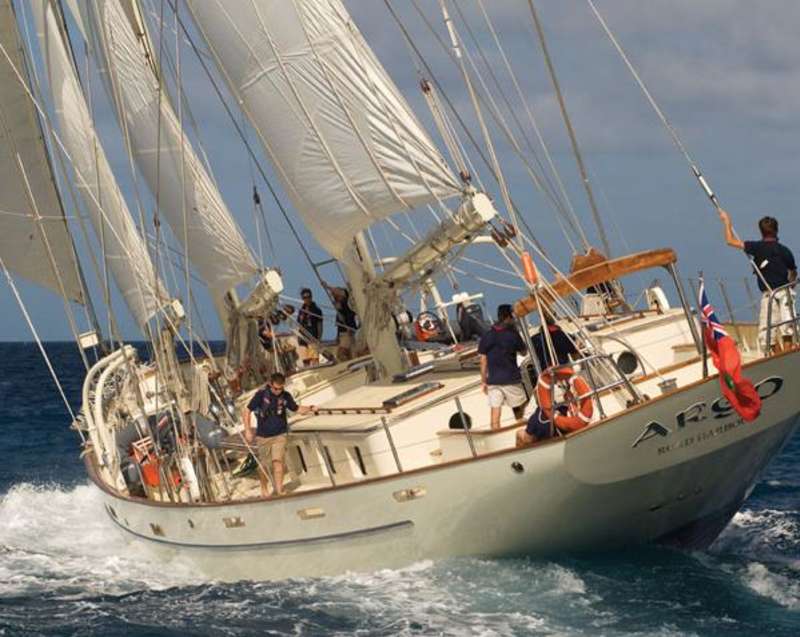
If you had told me in January 2023 that I would spend my summer on a 112-foot schooner, crossing the Atlantic with zero sailing experience, I would have laughed, and then asked what a foulie was.
My voyage was different from the typical Semester at Sea experience. Argo was small, with just 12 students and 6 staff, so there was nowhere to hide and no one to hide from. By the end, we were no longer a group of students and staff. We were a family.
Some of my favorite moments happened after dark. My watch team and I would lie flat on the deck inside what we called the “sparkle dome”: bioluminescence glittering in the water below and a galaxy of stars above, so that it felt as though we were floating in the middle of a sphere of light. With no cell service for days, there was nothing to look at but the ocean and nothing to listen to but each other. Those nights, I felt both the smallest and the luckiest I have ever been.
The ocean also gave me my favorite surprises. Crewmates would bang on my hatch window so that I would come up and see the dolphins, even when it wasn’t my watch. They knew how much I loved the marine life, and they cared enough to wake me for it. I can’t think of a better way to be loved.
Then there was the adrenaline. Our passage to the Azores brought near gale force winds and 3 to 4 meter swell in the pitch black. We crawled across the deck at 4 am, dodging flying fish and waves crashing over the stern, then spent the rest of the day being tossed around our bunks. It was uncomfortable and chaotic, and it produced some of the best laughter of my life. On calmer days, I was backflipping off the bow, climbing the mast to free a halyard shackle, and leading my first sail raise. The girl who struggled on her first sailing test and felt like the only one without experience learned to motivate her watch team through the 3 am boat checks that no one ever wants to do.
Our crew was divided into watch teams, groups that rotated through shifts steering, navigating, and keeping Argo safe around the clock. Over time, those teams became tight-knit units with their own traditions. That identity came to a head during the watch team challenge course, a friendly competition in which the teams raced against one another through a series of physical and teamwork-based tasks, including a run up a grassy, slippery hill. Watch Team Two won, and we celebrated it with the seriousness of an Olympic victory, complete with an aggressively chanted team name.
In port, we hiked and explored new countries together, and each place felt bigger because I was seeing it through the eyes of people who had become my closest friends. Our captain, Calum, joined our holiday traditions, told stories we will carry with us forever, and taught us silly songs. He showed us how to be a family and, more importantly, how to be part of one.
When the voyage ended, I walked the length of a dock in Gibraltar alone, leaving Argo and everyone aboard behind. It was one of the hardest goodbyes of my life.
But it wasn’t really a goodbye. Our entire crew is still in a group chat that texts daily. Argo taught me how to sail, but the people taught me what a crew truly is, and I know they will be close to me for the rest of my life.